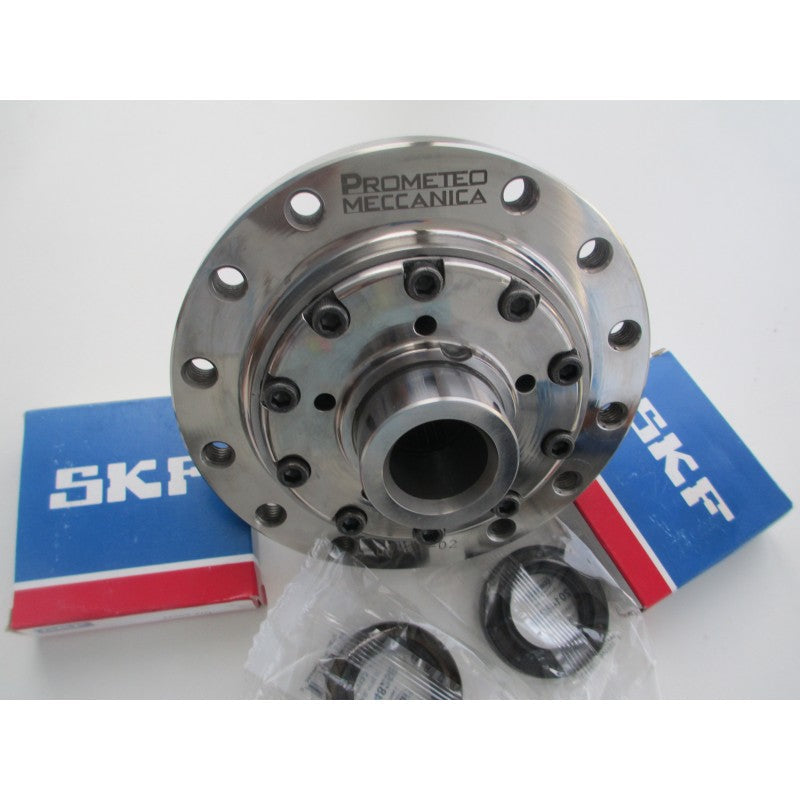
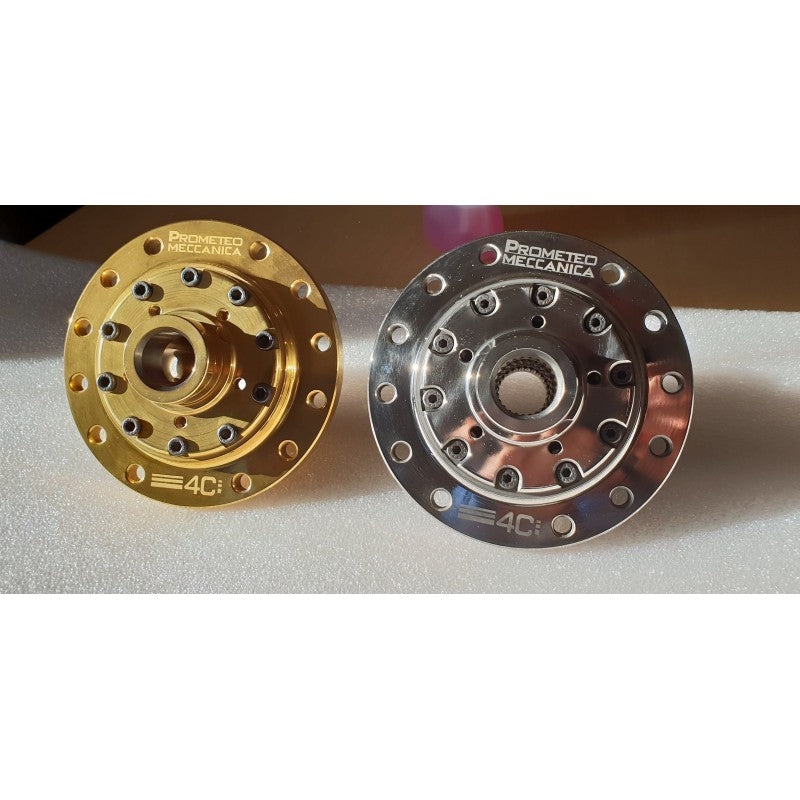
Differenziale Autobloccante Prometeo Fiat 500 ABARTH Cambio C510
Differenziale Autobloccante Prometeo Fiat 500 ABARTH Cambio C510
Impossibile caricare la disponibilità di ritiro
The Abarth 500-595 is equipped as standard with an electronic system called TTC, which SIMULATES a limited-slip differential: in practice, when one of the two drive wheels loses traction, the electronic control unit responsible for traction control sends a braking impulse to the brake caliper of the slipping wheel: the negative torque added to the wheel "fools" the normal differential, sending an equal torque to the wheel with greater grip. The TTC is certainly a valid and safe system, which ensures good vehicle control, however, we reiterate that it is not a limited-slip differential and does not guarantee the same performance that only a good limited-slip differential can provide.
If you usually use your Abarth 500-595 on the track during track days, or you don't like having to suffer the unpleasant slipping of the inner wheel at every corner exit taken a little too aggressively, then a true limited-slip differential might be right for you.
Our helical gear limited-slip differential, tested on vehicles with over 30 kgm of torque, allows the engine torque to be split asymmetrically, meaning that the wheel with more grip will always receive a surplus of torque compared to the wheel with less load. The locking percentage under acceleration is approximately 35%. We preferred not to go beyond this, as the Abarth 500 is and remains a road car.
The helical gear differential operates very progressively and does not create undesirable effects in normal driving.
The locking percentage under deceleration is limited to approximately 25%, so as not to affect braking and corner entry.
It is very difficult to explain the effect obtained in words, but the feeling you get when you open the throttle after the apex of a corner and do not feel the nose going off on a tangent, but pulling inwards, is something unknown to a front-wheel drive car with a standard differential.
Furthermore, the operation of our differential is compatible with the TTC.
How does a limited-slip differential work? First, let's consider the operation of the standard front differential.

The differential is a device that divides the engine torque coming from the gearbox exactly in half for each of the two half-shafts, regardless of the difference in the revolutions of the two wheels on the same axle. So, as shown in the figure, if 100 (the units are entirely arbitrary) is the input torque to the differential, a torque of 50 will end up on each wheel.
However, there is another important parameter to consider: the grip of the tires on the ground. In fact, torque can be "discharged" to the ground up to the limit of adhesion of the wheel; this limit is therefore proportional to the fraction of load acting on the wheel and to the coefficient of adhesion, which mainly depends on the consistency of the ground.
So, if one of the two front wheels ends up in an area with reduced grip (for example, on slippery asphalt), the torque that can be discharged to the ground by that wheel is reduced, since the wheel itself reaches the slipping condition. Due to the property of the differential stated above, which is to be a mechanism that divides the input torque into equal parts, we will have the same torque value also on the other wheel, which still maintains good grip.

As can be seen from the previous figure, if 30 is the value of the torque at the slip limit of the left front, the right wheel will also only be able to discharge a torque of 30 to the ground. And therefore, the total traction of the front axle is reduced to a value of 60, significantly lower than the 100 in the previous example.
If we install the Prometeo limited-slip differential instead of the normal differential, traction improves in these cases. Let's see how and by how much.
First of all, in conditions of good and homogeneous grip, the limited-slip differential behaves like a normal differential, as shown in the following figure.

However, if one wheel loses grip, the other receives approximately 35% more torque than it would with a normal differential. The total torque discharged to the ground by the front axle is therefore higher than that discharged by a common differential. The following figure is very explanatory of this mode of operation.

The 35% locking percentage is the best compromise found through numerous tests performed in different conditions. We must not forget that an excessive locking percentage would have made the vehicle too understeer in normal driving, with consequent problems in handling. And, on the other hand, too small a locking percentage would have reduced the benefits of the limited-slip differential, making it objectively useless.